
How to join the EuRREB registries
EuRREB – European Registries for Rare Endocrine and Bone conditions supports patients, healthcare professionals, and researchers by collecting data on rare endocrine and bone diseases. Our mission is to improve research, care and treatment for those affected by these rare diseases. Through our two key registries, e-REC and Core Registry, we offer a platform to collect essential data and foster collaborative research across Europe.
Joining the EuRREB Registries is a straightforward process designed to ensure secure, ethical, and collaborative participation across Europe. New centres can begin participation by following the steps below.
|
|
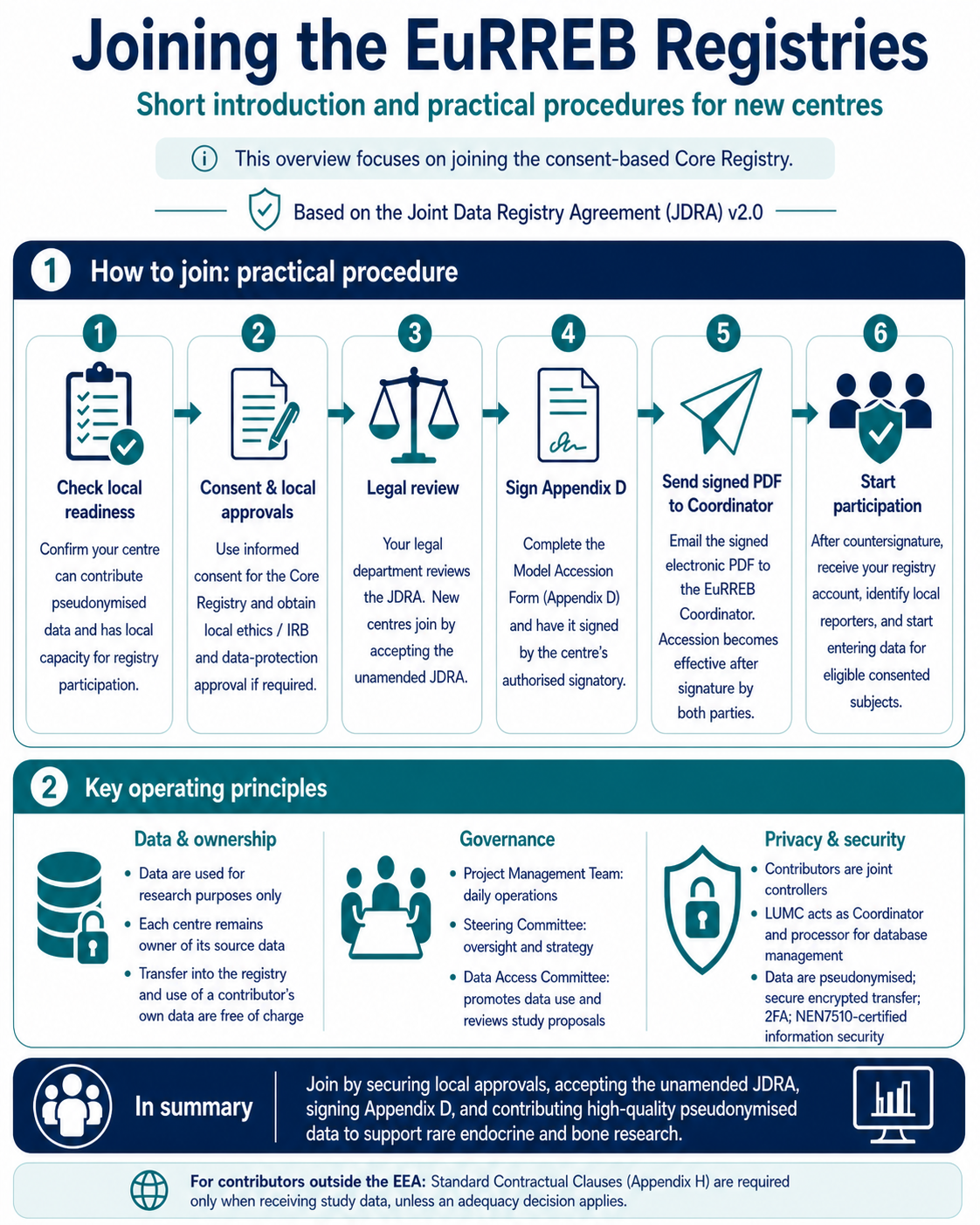
Check Local Readiness
Before joining, confirm that your centre is able to contribute pseudonymised data and has the local infrastructure and capacity required for registry participation. Please consider the availability of eligible patient data, local staffing and reporting capacity, data protection and governance readiness, and technical ability to securely transfer pseudonymised data.
Consent and Local Approval
Participating centres must use informed consent for the Core Registry, ensure GDPR compliance and obtain local ethics approval. Please find Patient Information Folders with Informed Consent templates in different languages and all the necessary documents to obtain local approval from your ethics committee or institutional review board.
Legal Review of the JDRA
Your institution’s legal department reviews our Joint Data Registry Agreement (JDRA). In the meantime, you may already start entering data, provided your ethics committee agrees. You can register for an account or if you already have an account login. Please note that we will not be able to share or use any data entered into our database until a signed agreement is in place. As a new centre you can join by accepting our unamended JDRA to ensure harmonised governance across participating centres. To take away some of your concerns or to find out more about our JDRA, please go to our FAQ section and use the DPO/Legal Department button to go to the JDRA section.
Sign Appendix D and send
Complete the Model Accession Form (Appendix D) and have it signed by the authorised signatory of your institution. Send the JDRA with the signed Appendix D as PDF to us by email: registries@lumc.nl. We will countersign and send you a copy with both signatures for your records. Participation becomes effective after signature by both parties, only then we are able to share your data with other participating centres.
Start Participation
You can begin contributing entering eligible patients into the Core Registry. Watch our videos for a quick walkthrough of our platform and dashboard, to add a patient and outcomes, to assign PROMs. Need our help to enter your data? We are here to assist you! We offer online support and can help you to enter your data or answer any questions. You can log in for a drop-in (online support) session, add the session to your calendar and log in with ZOOM or contact us at registries@lumc.nl.
Obtain Registry Data
To obtain registry data please complete our Data Request Form and read our Data Access Policy. You can find these documents on our Obtaining Registry Data page. For contributors located outside the European Economic Area (EEA), Standard Contractual Clauses (Appendix H of JDRA) are required only when receiving study data, unless an adequacy decision applies.
Key Operating PrinciplesEuRREB operates according to shared principles that support secure, ethical, and collaborative rare endocrine and bone research. Data and Ownership
GovernanceThe registries are managed through a structured governance framework. Privacy and SecurityProtecting patient privacy and ensuring secure data management are central principles of EuRREB. Security measures include: pseudonymised data collection, secure encrypted data transfer, two-factor authentication (2FA), and GDPR-compliant safeguards. |